Turn repeatable field knowledge into a process your whole team can follow, score, and prove.
See it in action
Great service companies usually have a set of quality steps their best technicians always follow. The problem is getting that same discipline across every crew, every visit, and every new hire. Service Opus checklists help translate safety routines, installation steps, inspection standards, and closeout expectations into repeatable execution that the office can actually verify.
Business Needs It Solves
Consistent service quality: Make sure important steps are not skipped just because the day is busy or the technician is new.
Safety and compliance proof: Capture the completion data, notes, and photo evidence needed for regulated or high-risk work.
Faster onboarding: Give newer field staff a structured path through inspections, maintenance visits, and closeout routines.
Better accountability: Managers need a clear record of what was completed, who completed it, and where results fell short.
How Service Opus Helps
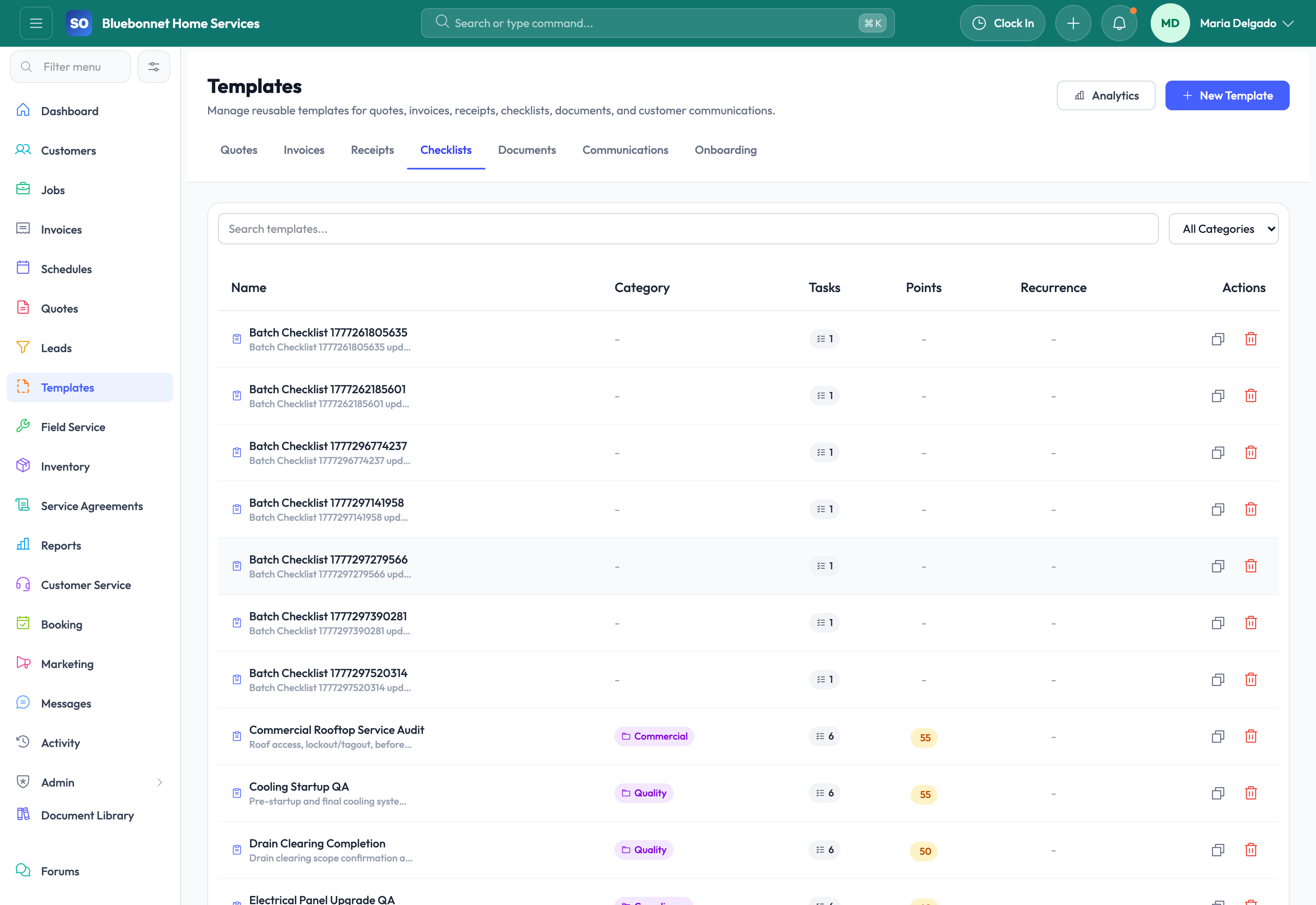
Template library: Build checklist templates for safety, maintenance, installation, inspection, compliance, and other repeatable job types.
Flexible task types: Use checkbox, text, number, and photo tasks depending on the kind of proof or response you need.
Required tasks and scoring: Mark critical steps as required, assign point values, and use pass-fail thresholds to reinforce quality expectations.
Conditional logic: Show or hide tasks based on earlier answers so complex inspection flows stay relevant without becoming cluttered.
Job-level execution: Attach one or more checklists to a job, track progress, capture notes and photos, and keep completion data inside the job record.
Recurrence and reuse: Support recurring checklists and template cloning so standard processes stay easy to maintain across teams.
What Good Checklist Use Changes
Checklists raise the floor on field quality. They help experienced technicians stay consistent, help newer technicians work with confidence, and give the office better evidence for customer communication, compliance reviews, and completion approval. They are especially valuable for inspection-heavy, safety-sensitive, or recurring maintenance businesses.
Quality control: Use required checklist tasks, scoring, and photo proof for the steps that matter most to safety, compliance, and customer-facing completion standards.
User Guide
Standardize inspection, safety, quality, and closeout routines across teams and job types.
Best For
Service managers defining required field steps.
Technicians completing inspections or closeout tasks.
Operations leaders reviewing quality and compliance trends.
Before You Start
Create checklist templates by trade, service type, job status, or asset type.
Decide which questions require evidence, notes, photos, or pass/fail responses.
Set expectations for when checklist completion blocks closeout.
Recommended Workflow
Choose or create the checklist template for the process.
Attach the checklist to the job, service type, or workflow where it applies.
Have technicians complete required items from the field.
Review failed, skipped, or exception responses before closing the job.
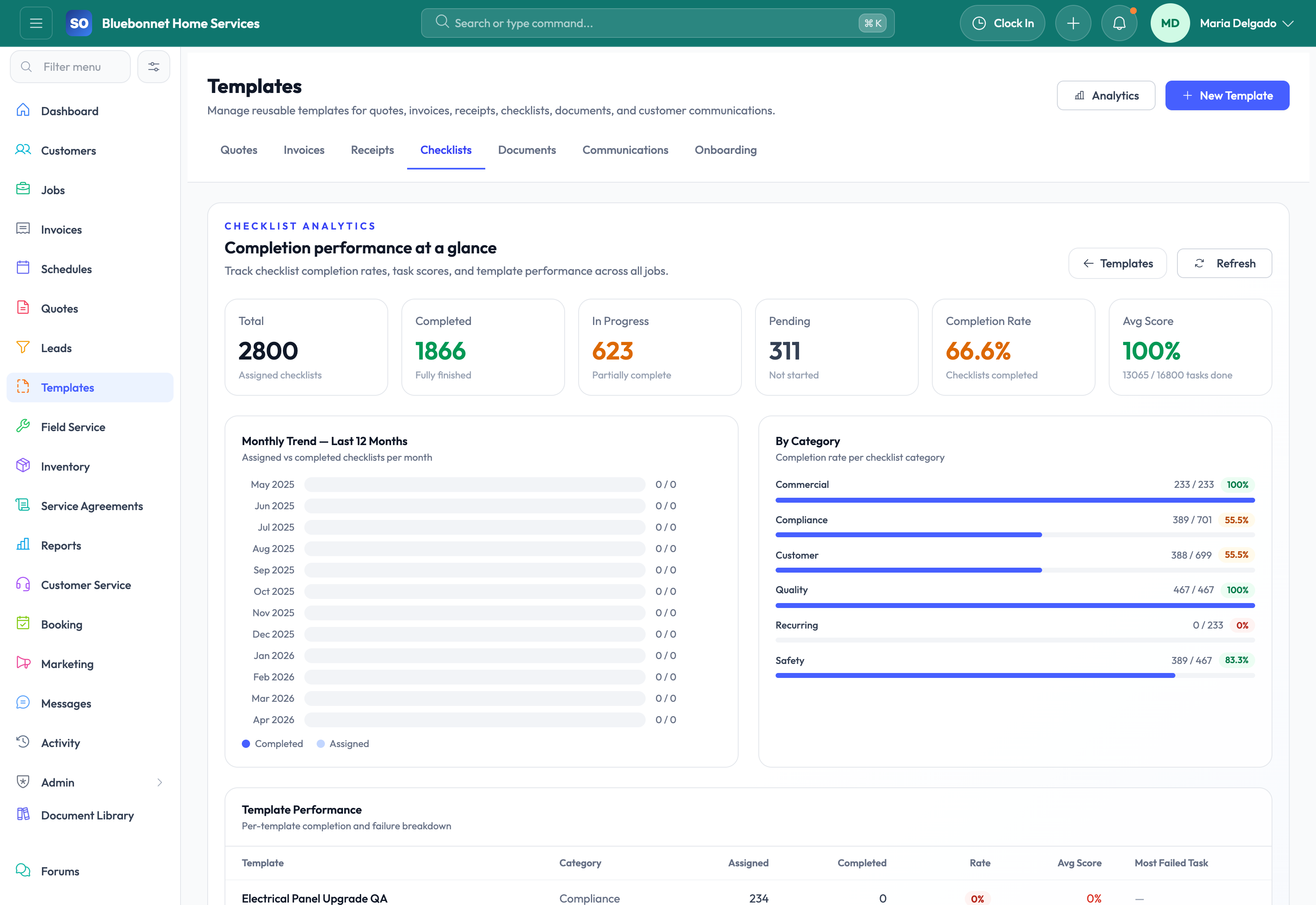
Use analytics to identify training needs or repeat quality issues.
Review Checklist
Required items cannot be bypassed without a reason.
Photo or note evidence is attached where required.
Failed checklist responses produce follow-up action.
Templates are reviewed after process or compliance changes.
Common Handoffs
Jobs for assignment and closeout.
Field Service for technician completion.
Documents and Media for proof attachments.
Reporting and Analytics for completion trends.
Ready to apply this workflow?
Use the guide to evaluate fit, then start a trial or talk through how Service Opus maps to your team, trade, and current operating process.